Relay Attack Guide: How Keyless Car Theft Works
A relay attack is a way to steal a car with keyless entry without ever touching the key. Thieves use two radio devices to extend your key fob's signal from inside your home to your car, which then unlocks and starts as if the key were right there. The simplest defense is to keep the key fob in a Faraday box or pouch, which blocks its signal.
How a relay attack works
- The search. One thief walks near your front door, window or wall with a relay device that listens for your key fob's signal.
- The relay. The device boosts that signal and passes it to a second device held by an accomplice standing next to your car.
- The theft. Your car believes the key is within range, so it unlocks. Because it also allows push-button start, the thieves can start the engine and drive away.
The attack is quick and quiet, and it leaves no broken glass or damaged locks behind.
Which cars are at risk?
Any vehicle with a keyless (proximity) entry key and push-button start can be targeted, whatever the make. In a 2016 test by the National Insurance Crime Bureau (NICB), a relay device opened 19 of 35 vehicles and started and drove away 18 of them. In Germany, the automobile club ADAC has tested hundreds of keyless models: in its 2024 results, about 9 in 10 of the 698 cars tested could be opened with a relay attack. Cars whose keys use ultra-wideband (UWB) technology resisted the attack in ADAC testing.
Car theft remains common in the U.S.: 659,880 vehicles were reported stolen in 2025, according to the NICB.
Not sure what kind of key you have? If you can unlock the doors by touching the handle and start the car without taking the key out of your pocket, it's keyless. Check your car in 30 seconds.
How to protect a keyless car from relay theft
- Block the signal. Store the key fob in a Faraday box at home and carry a Faraday pouch when you're out. Both enclose the key in shielding that stops its radio signal, so there's nothing to relay.
- Protect the spare key too. A spare fob in a kitchen drawer transmits just like the one you use every day.
- Keep keys away from doors and windows. Distance alone isn't reliable, because relay devices extend range, but it helps.
- Check your key's settings. Some manufacturers let you switch off keyless entry or put the fob to sleep. Your owner's manual or dealer can tell you whether yours does.
- Add a visible deterrent. A steering wheel lock makes a relayed car harder to drive away.
How to test a Faraday case at home
Put your key fob in the case and close it. Walk up to your car and pull the door handle. If the car stays locked, the signal is blocked. Open the case, try again, and the car unlocks. If your car opens while the key is inside a closed Blackeyz case, send it back within 100 days.
Sources
- National Insurance Crime Bureau (NICB), relay attack device test, December 2016.
- NICB, 2025 Vehicle Theft Report.
- ADAC, keyless entry test results, 2024.
One click.
Zero signal.
A relay attack is when thieves capture the signal of a keyless key fob left inside your home, then relay it to your car to unlock and start it. No break-in, no noise. A closed Faraday case blocks that signal, so there's nothing to relay.
-
Drop your key in
When you get home, put it in the case by the door. One habit, like setting down your watch.
-
Close it: click
The lid locks shut. Your key is shielded on every side.
-
Sleep easy
No signal gets out, so there's nothing to intercept. In the morning, open it and go.
Box or pouch: which one do you need?
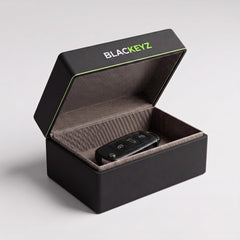
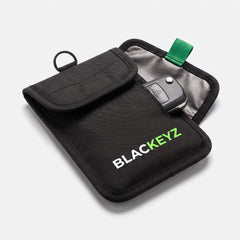
Both block your key fob's signal using the Faraday cage principle. The rigid box protects your keys at home; the pouch protects them on the go. Many households use both.
At a glanceBoth block your key fob signal |
 BoxAt home BoxAt home
|
 PouchOn the go PouchOn the go
|
|---|---|---|
| Best for | At home, by the door | On the go: pocket, bag, office |
| Format | Rigid, sits on a shelf | Soft, folds flat |
| Closure | Positive click: you know it's shut | |
| Key protection | Hard shell, lined interior | |
| Price | From $29 | |
Not sure which one?Check my car
| Shop boxes | Shop pouches |
The smart setup: a box by the door, a pouch in your bag.
Shop allFrequently asked questions
Everything you need to know before you protect your key.
- Ships within 24-48 hours
- 100-day returns
- 2-year warranty
Still have a question?
Send us a message. We reply within 24 hours.
What is a relay attack?
A relay attack is a keyless car theft technique. One thief stands near your home with a device that picks up your key fob's signal and relays it to an accomplice standing next to your car. The car thinks the key is nearby, so it unlocks and starts. No break-in, no broken glass.
Which cars are vulnerable to relay attacks?
Any car with a keyless (proximity) entry key and push-button start can be targeted, whatever the brand. In ADAC testing, about 9 in 10 keyless models could be opened with a relay attack; keys using ultra-wideband (UWB) technology resisted the attack.
Do Faraday boxes and pouches really work?
Yes, when they fully enclose the key. A Faraday box or pouch surrounds your key fob with conductive material that blocks the radio signals it sends and receives, so there is nothing for a relay device to pick up. You can verify it yourself in 10 seconds: close the case, then try your car's door handle.
Can't I just wrap my key fob in aluminum foil?
Foil can block the signal, but only if every side is fully covered, and it tears and creases quickly with daily use. A purpose-built Faraday case gives you the same shielding every time you close it, without guesswork.
Does my key work normally once it's out?
Yes, instantly. As soon as you open the case, your key fob transmits as usual. Nothing to reset or re-pair.
Tonight, close the case.
One habit when you get home, and your key fob's signal never leaves the house.
- Ships within 24-48 hours
- 100-day returns
- 2-year warranty